How to Make a Small Room Feel Bigger Without Adding Square Footage
A small room does not always need more square footage. If you are trying to figure out how to make a small room feel bigger, start with the way the existing space is used. Fewer visual breaks, better lighting, and a smarter layout can often make a noticeable difference.
Before changing anything, ask one simple question: What exactly is making this room feel small?
It could be bulky furniture, dark corners, a window hidden behind curtains, too many contrasting colors, or simply too much visual clutter.
Once you identify the main problem, choosing the right solution becomes much easier.

1. Simplify the Color Scheme
A small room can feel even smaller when the walls, ceiling, doors, trim, and accent wall all strongly contrast with one another.
Using related colors can make the room feel more connected.
For example:
choose wall and trim colors from the same color family;
make the ceiling slightly lighter than the walls;
coordinate doors with either the walls or the trim.
That does not mean everything has to be white. Soft grays, muted greens, light taupes, calm blues, and other understated colors can work very well in smaller spaces.
The goal is not simply to make the room brighter. It is to reduce unnecessary visual boundaries.
2. Make Better Use of the Room’s Height
If the ceiling is not very high, a strong contrast between the walls and ceiling can make that boundary even more noticeable.
Using similar tones can soften the transition.
Vertical elements can help too:
curtains hung close to the ceiling;
tall mirrors;
vertically arranged artwork;
slim floor lamps.
The ceiling does not physically become higher, but the eye is encouraged to move upward, which changes how the room feels.

3. Do Not Let Curtains Shrink the Window
Natural light is especially valuable in a small room.
If curtains are mounted exactly at the width of the window, they may cover part of the glass even when they are open.
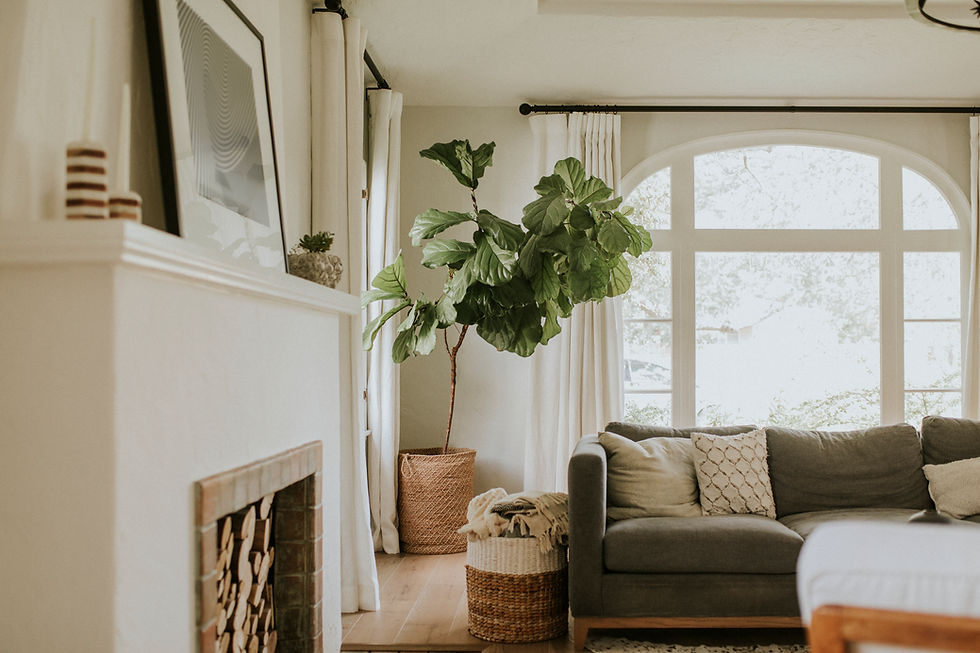
A curtain rod installed slightly higher and wider than the window can leave more of the glass exposed. The window appears larger, and more daylight can enter the room.
Curtains are not always necessary, either. In some spaces, simple blinds or shades keep the wall cleaner and allow the window itself to stand out.
4. Put Mirrors Where They Actually Help
A mirror does not automatically make a room feel larger. What it reflects matters.
A well-placed mirror can reflect:
a window and natural light;
an open doorway;
a clean part of the room;
a longer view through the space.
A mirror facing a television, cluttered desk, or crowded corner may simply double the visual noise.
And if the mirror is large or heavy, installation matters too. The wall type, stud locations, and mounting hardware should all be considered.

5. Keep More of the Floor Visible
The more floor you can see, the more open a room often feels.
That is why one oversized piece of furniture can affect a small room more than several smaller details.
For example:
a bulky bookcase can sometimes be replaced with wall-mounted shelves;
a floor lamp can be replaced with a wall-mounted fixture;
a large TV stand may be unnecessary if the television is mounted and the storage below it is simplified.
That does not mean every item should move onto the walls. A wall overloaded with shelves, pictures, brackets, and decor can feel just as crowded.
The goal is balance.

6. Consolidate Storage
Small rooms often end up with many separate storage solutions.
A basket in one corner. A narrow shelf on another wall. A small cabinet. Hooks. Another organizer behind the door.
Each one may be useful, but together they can break the room into too many small zones.
It is often better to concentrate storage in one area.
In a bedroom, better closet organization may eliminate the need for an extra dresser. In a home office, shelves above the desk may provide storage without adding another piece of furniture to the floor.
Good storage should reduce visual clutter, not simply move it somewhere else.
7. Light More Than Just the Center of the Room
One bright ceiling fixture does not always make a room feel larger.
If the corners stay dark, those areas can visually disappear.
A better approach may be to combine several light sources:
general ceiling lighting;
a wall sconce;
a table or floor lamp;
task lighting.
This is especially helpful in rooms with only one window or limited natural light.

8. Create Longer Visual Lines
Our eyes use lines to understand the size and shape of a room.
Long, uninterrupted lines can make a space feel more expansive, while too many short elements can make it feel broken up.
Examples include:
a curtain rod wider than the window;
curtains running from near the ceiling toward the floor;
a long floating shelf;
consistent flooring between connected spaces;
clean, continuous baseboards.
You do not need to use all of these. One strong visual direction is often enough.
9. Do Not Add an Accent Wall Just Because It Is Popular
An accent wall can add depth, but only when it highlights the right part of the room.
It may work well behind a bed, around a fireplace, or on a clean wall at the far end of the room.
But a short wall interrupted by a door, thermostat, switches, and furniture may feel even busier when painted a contrasting color.
Before choosing an accent wall, ask: Is this really the wall I want people to notice?
If not, a more consistent color scheme may work better.
10. Fix the Details That Make the Room Feel Unfinished
Sometimes the problem is not the size of the room at all.
Poorly patched drywall, old wall anchors, damaged baseboards, loose trim, unused shelves, or visible cords can create constant visual clutter.
Once the walls are repaired, the trim is cleaned up, unnecessary hardware is removed, and the room is freshly painted, the same space can feel much cleaner and more open.
There is a useful rule here:
Improving a small room does not always mean adding something. Sometimes removing what no longer belongs makes the biggest difference.

How to Make a Small Room Feel Bigger: Where Should You Start?
Do not try to use every idea at once.
If the room feels dark, start with the window, lighting, and wall color.
If it feels low, focus on the ceiling and vertical lines.
If it feels narrow, reduce visual breaks and preserve longer sight lines.
If it feels crowded, free up floor space and consolidate storage.
If it feels unfinished, start by repairing the walls, trim, doors, and other details.
Often, two or three well-chosen changes are enough to make a room feel completely different.
A Small Room Does Not Always Need a Big Remodel
Making a room feel more open does not usually require a full remodel. Some changes cost nothing, such as rearranging furniture or removing unnecessary items.
Others involve relatively small projects: repainting walls and ceilings, repairing drywall, updating trim, improving lighting, or installing shelves or a large mirror.
Planning a Few Updates Around Your Home?
Tools & Hands provides handyman and home improvement services throughout Chicago’s Northwest Suburbs.