Space Anatomy: 10 Kitchen Layout Mistakes You'll Regret Later
Updated: Jul 11
When people order a new kitchen, they look at cabinet fronts and countertops. This is normal—beauty catches the eye first. But after installation, it often turns out the real problem lies in the spatial logic.
A kitchen can look expensive but be a daily annoyance. Nowhere to put grocery bags. An open dishwasher blocking traffic. An island stealing precious square footage, and dust gathering above beautiful upper cabinets.
A good kitchen starts with math, not color. Below are 10 common kitchen layout mistakes and the exact metrics that will help you spot the problem while it's still on paper.
1. Aisles Are Too Narrow
Two rows of cabinets might look neat on a floor plan, but in real life, a narrow aisle turns cooking into a stressful experience.
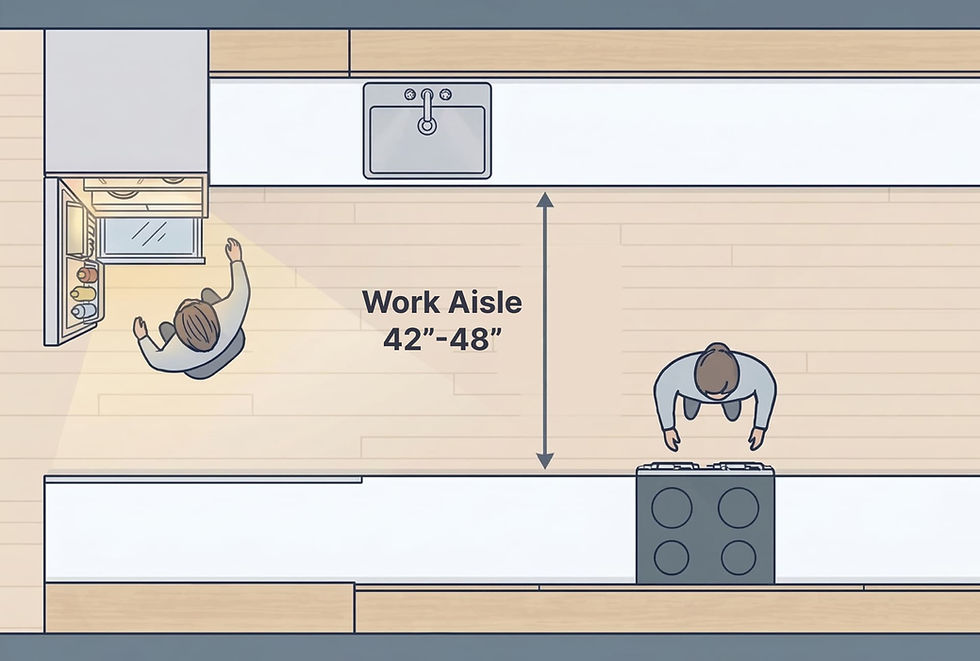
Benchmark: It is important to distinguish between zones. A "walkway" is a transit path (e.g., passing through the kitchen to the living room)—here, 36 inches is sufficient. A "work aisle" is where you stand at the counter, cook, or open drawers. The comfortable minimum here is 42 inches. If two people cook regularly, allow 48 inches.
Solution: Request the exact width of all aisles on the blueprint. Change the layout before ordering if the main work arteries are squeezed.
2. Base Cabinets with Shelves Instead of Drawers
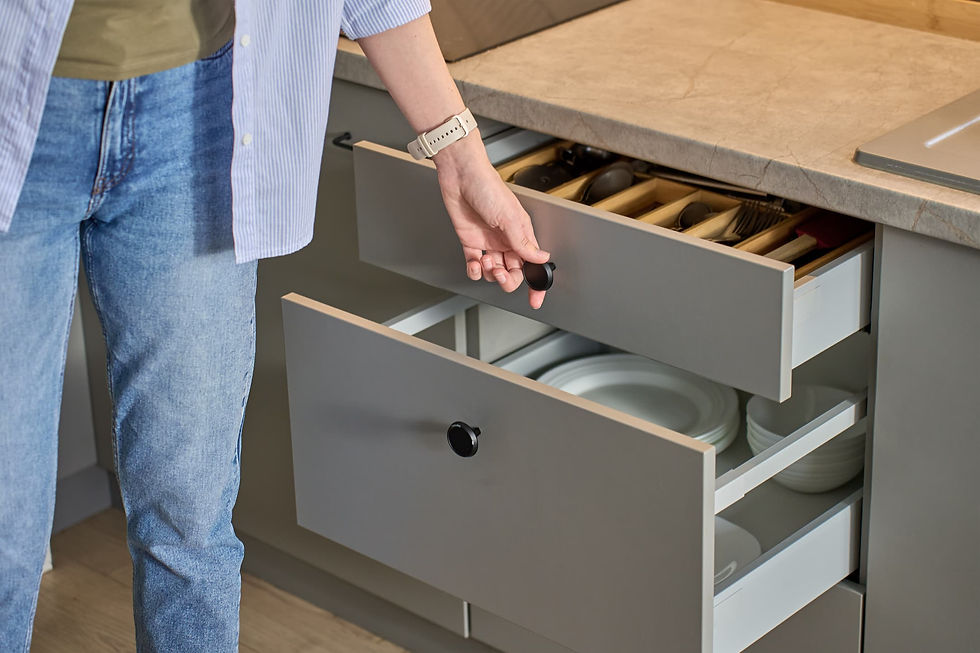
Deep base cabinets with static shelves are a dead zone. To reach a pot in the back, you have to take out half the contents.
Benchmark: Given the standard base cabinet depth of 24 inches, static shelves always lose out in convenience to pull-out systems.
Solution: Include 1–2 wide banks (30–36 inches) of full-extension drawers for pots, pans, and everyday dishes right from the start.
And to avoid wasting space in tricky corners, use modern hardware solutions. We detailed how to make every inch work in our article on [convenient mechanisms for kitchen dead zones: Magic Corner, LeMans, and other smart systems].
3. Door and Drawer Conflicts
The fridge hits the wall, the oven blocks the walkway, or a base drawer bangs against an adjacent handle. These mistakes are invisible on a pretty 3D rendering; they only reveal themselves in motion.

Benchmark: Every open door needs its own clearance. There should be at least 21 inches of standing space in front of an open dishwasher. Base drawers (typically 20–22 inches deep) need enough clearance to extend fully without you backing into a wall or the island. An open oven door shouldn't block the path for other family members.
Solution: Mentally (or on the plan) open the fridge, oven, dishwasher, and adjacent drawers all at once. If their paths intersect, the layout needs a redesign.
4. A Broken Workflow
The classic cooking scenario goes like this: grab ingredients (fridge) → wash (sink) → prep (countertop) → cook (stove). This is your main workflow. If it's broken, the kitchen drains your energy.

Benchmark: The distance between the main work centers should be between 4 and 9 feet, and the total length of the work triangle should not exceed 26 feet.
Solution: Take your kitchen plan and draw your path with a pencil from the fridge to the stove. If the lines form a complex zigzag, cross the island, or require more than two steps between the sink and the stove, rearrange the zones.
5. The Dishwasher Is Too Far From the Sink
Carrying wet dishes across the kitchen drips water on the floor and drags out the cleanup process. It’s not a disaster, but it is the kind of daily annoyance that kills comfort.
Benchmark: The closest edge of the dishwasher should be within 36 inches of the sink.
Solution: Design the sink, dishwasher, and trash pull-out as a single, uninterrupted cleanup station.
6. Lots of Counter Space, But in the Wrong Places
You can have a long countertop and still struggle if there's nowhere to set groceries near the fridge, or nowhere to place a hot pot next to the stove. It's not about the total square footage; it's about strategic placement.
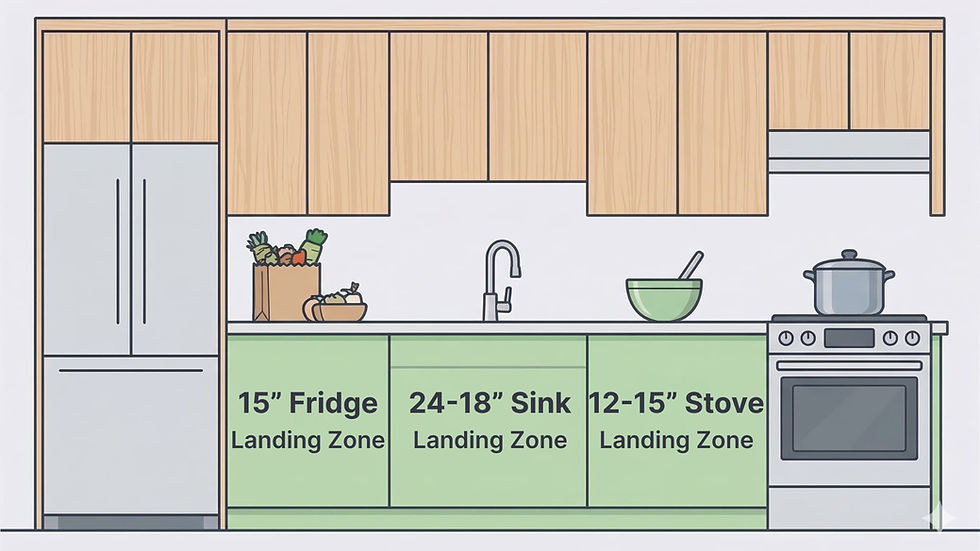
Solution: Incorporate mandatory "landing zones" on the floor plan next to every key activity hub: the fridge, sink, and stove.
Benchmark: For comfortable prep, you need: 15 inches of landing space near the fridge; 24 and 18 inches on either side of the sink; a continuous 36 × 24-inch main prep zone; and 12 and 15 inches on either side of the stove.
7. An Island Just for Looks
An island makes a project look more premium and is associated with modern design. But if it eats up walkway space, it turns from an asset into an obstacle.

Benchmark: You need 42–48 inches of working clearance around the island. If you plan for bar stools, allow 22–24 inches of width per person.
Solution: Ask yourself: "What function does this island serve?" If you have enough square footage, it fits the guidelines, and you love it—great, keep it. But if you have to narrow your aisles to a critical 36 inches just for the visual effect, replace it with a peninsula or keep the center open.
8. The Dead Zone Above Upper Cabinets
Leaving a 10–12 inch gap between your cabinets and the ceiling is a classic design oversight. This space quickly becomes a "dust catcher" and a grease trap that is nearly impossible to clean, while visually cutting the height of your room in half.
Benchmark: In a standard kitchen with 8-foot ceilings, opting for 42-inch tall upper cabinets instead of the standard 30-inch version increases your storage capacity by approximately 25% without taking up any extra floor space.
Solution: Design cabinets to be full-height. If extra-tall units aren't an option, close the gap with a matching riser panel or bulkhead. This eliminates "grease traps".
9. A Single Ceiling Light
A kitchen that is bright during the day turns gloomy in the evening. Standing at the counter, you block the only light source with your back and work in your own shadow.
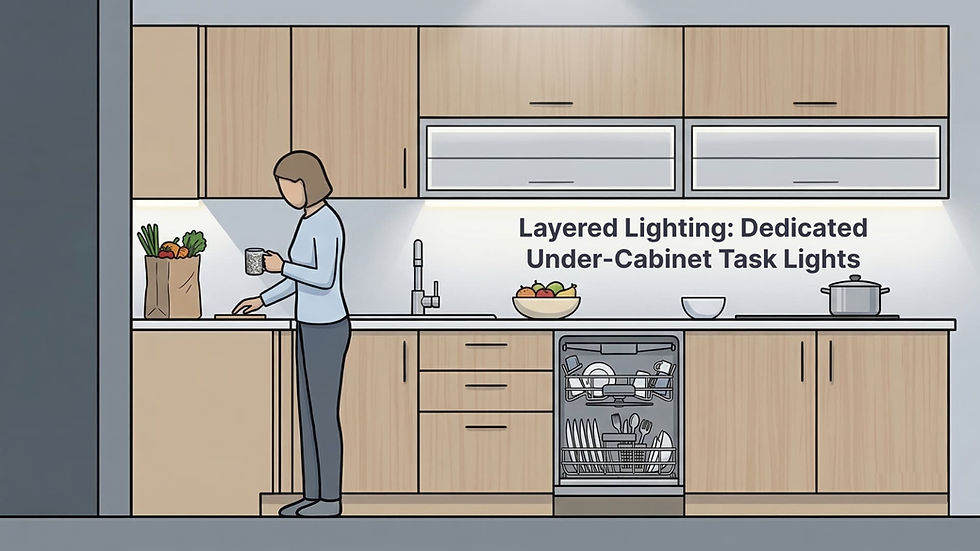
Benchmark: Any prep zone wider than 36 inches requires dedicated task lighting.
Solution: Plan for layered lighting: supplement the ambient ceiling light with mandatory under-cabinet LED lighting.
10. The Range Hood as Mere Decor
A vent hood is often chosen as an afterthought, based purely on aesthetics. If it fails to capture steam and grease, your kitchen surfaces and cabinet fronts will quickly become coated in a sticky film.

Benchmark: The hood should be at least as wide as the cooktop. Installation height: 20–24 inches above an electric range and 24–30 inches above a gas range. Exhaust capacity—minimum 100 CFM.
Solution: Choose the hood at the same time as the stove, strictly following the manufacturer's technical requirements for mounting height and power.
The Golden Rule to Avoid Kitchen Layout Mistakes
Bad kitchens rarely look bad on paper. Walkways seem sufficient, and the island looks like it belongs. But a kitchen is tested by real life: in the morning rush, during a deep clean, or while cooking a big meal.
That is why the most important question to ask when approving a design is not "Does this look beautiful?" but "Will this be comfortable to live in every day?"
A Good Plan Needs Flawless Execution
Don't let uneven gaps ruin a perfect layout. Tools and Hands provides expert kitchen assembly and installation in the Chicago Northwest Suburbs. We make sure your new kitchen works flawlessly.