Hardwired vs. Battery Video Doorbell: Which Is Better for Your Home?
Updated: Jul 18
A video doorbell helps you see visitors, receive package alerts, and monitor your entrance when you are away. But before choosing a model, you need to decide how the device will be powered.
When comparing a hardwired vs battery doorbell, the right choice depends on your existing wiring, preferred installation location, indoor chime, and everyday routine.
The Main Difference

A hardwired video doorbell connects to the low-voltage wiring used by a traditional doorbell. It receives continuous power and may work with your existing indoor chime.
A battery video doorbell runs on a rechargeable battery. It usually does not require existing wiring, giving you more flexibility when choosing where to mount it.
Hardwired vs. Battery Doorbell: Quick Comparison
Feature | Hardwired Doorbell | Battery Doorbell |
Existing wiring | Usually required | Usually not required |
Power source | Continuous | Limited by battery level |
Charging | Typically unnecessary | Required periodically |
Indoor chime | May work if compatible | Often uses an app or wireless chime |
Transformer | Must meet power requirements | Usually not needed |
Placement | Influenced by wiring | More flexible |
Power, Charging, and Battery Life
The biggest practical difference is ongoing maintenance.
A hardwired doorbell receives continuous power, so it typically does not need to be removed for routine charging. This can be convenient at a busy front entrance with frequent visitors, deliveries, and motion alerts.

A battery doorbell must be charged periodically. Battery life may be affected by:
frequent motion detection;
regular use of live video;
a weak Wi-Fi signal;
recording and notification settings;
extreme outdoor temperatures.
A doorbell facing a busy street may need charging more often than one installed at a quiet side entrance.
What If You Already Have Doorbell Wiring?

Existing wires can make a hardwired doorbell a practical choice, but visible wiring does not always mean the system is ready for a modern video doorbell.
The wires may be disconnected, damaged, too short, or connected to an older transformer that does not provide enough power.
The original doorbell location may also create a poor camera angle. In that case, a wedge or corner mount may be needed for a clearer view of visitors and packages.
Modern video doorbells can require more power than an older mechanical button. A transformer upgrade may be needed when the existing transformer does not meet the manufacturer’s requirements or the new doorbell repeatedly loses power.
Which Type Works Better for Your Entrance?
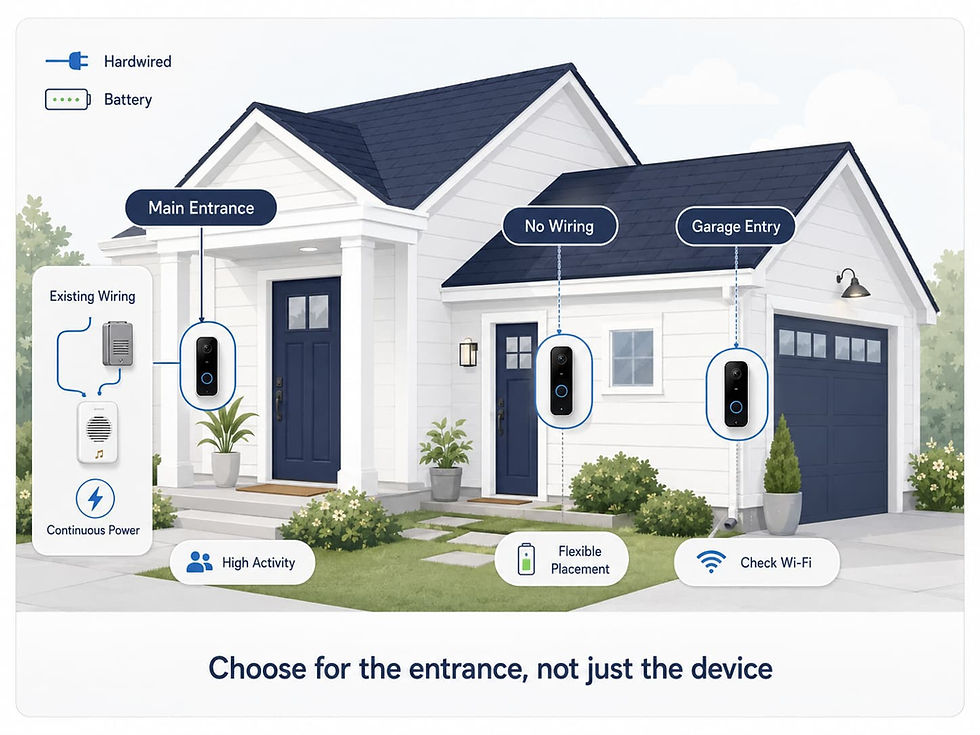
A hardwired doorbell may be a good fit when:
usable doorbell wiring is already present;
the device will be installed at a busy main entrance;
you want to use a compatible indoor chime;
you prefer continuous power without routine charging.
A battery doorbell may be more practical for:
side doors, back doors, and detached garages;
entrances without existing wiring;
rental properties where permanent electrical changes are not preferred;
locations where more flexibility in camera placement is needed.
Neither option is automatically better. The right choice depends on your entrance, existing wiring, preferred chime, and how often you are willing to charge the device.
Need a Video Doorbell Installed?
Tools & Hands installs hardwired Ring and Google Nest doorbells across Chicago’s Northwest Suburbs, including wiring checks and transformer upgrades when needed.


